Lieke Asma
A philosophical perspective on psychological issues

I investigate how unconscious discrimination arises and how we can reduce it. The emphasis is on our relationships. Discrimination occurs in contact with others, often remains invisible there, and must be brought to light and resolved precisely there.
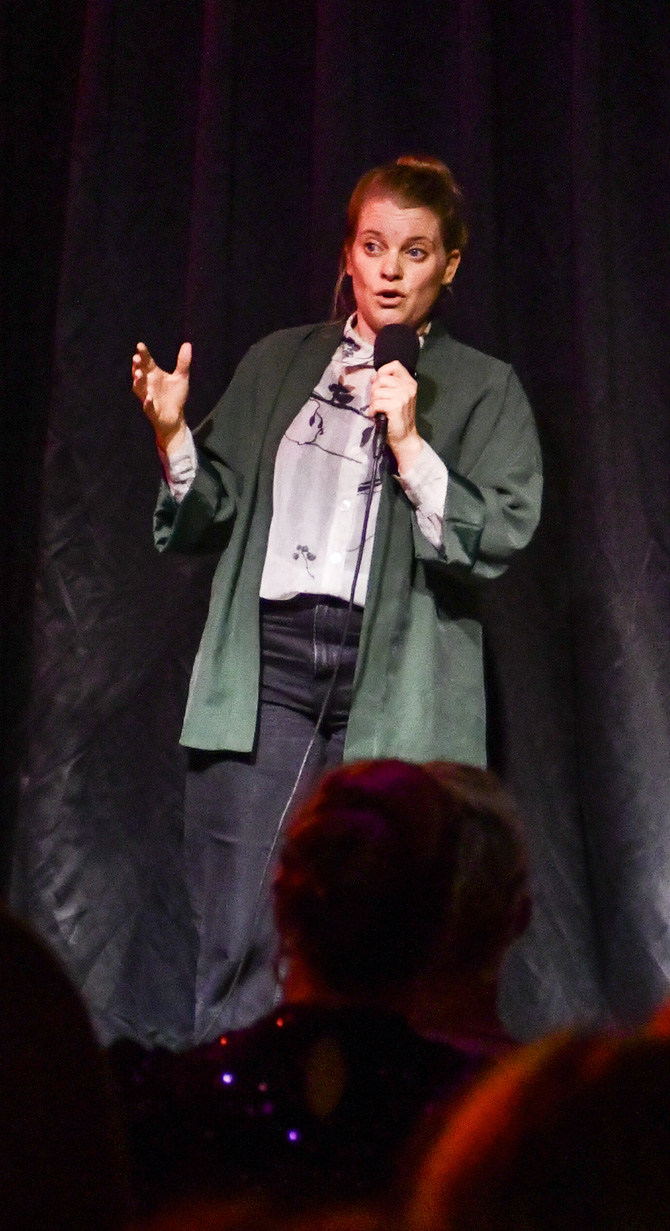

About Lieke
Philosopher and psychologist
I hold a PhD in philosophy and psychology. As a researcher at the Munich School of Philosophy, I focus on unconscious discrimination and prejudice. In 2025, I received a research grant from the Deutsche Forschungsgemeinschaft for the second time. My work appears in international academic journals. I consider it just as important to translate that research to a broader audience and to practice.
I am at home with philosophical issues and also know what is involved in psychological research. In that research, assumptions play a major, often invisible, role. I ask critical questions about them and counter them with an alternative perspective, inspired by ecological psychologists such as Gibson and Reed, and by Anscombe and Wittgenstein.
I am at home with philosophical issues and also know what is involved in psychological research. In that research, assumptions play a major, often invisible, role. I ask critical questions about them and counter them with an alternative perspective, inspired by ecological psychologists such as Gibson and Reed, and by Anscombe and Wittgenstein.
Munich School of Philosophy
Profile
To make unconscious discrimination visible and to reduce it, it is crucial to consider people in their context. We are not isolated beings, but act and decide in direct interaction with our social and material environment. In this regard, it is crucial to avoid dualisms and not to view the individual and the context as two separate forces.
Lectures & Workshops
How can you disadvantage someone without intending to or noticing? In these lectures, you will discover how unconscious discrimination arises in interactions with others, why your biases sometimes help and sometimes hinder your decisions, and what the latest research on this topic reveals. You will begin to look at your own judgments differently, and at what you can do about it together with others.
Dutch or English
Lecture or workshop
45 minutes to an entire day
Number of participants is flexible
Lecture
How discrimination occurs unconsciously and unintentionally
You can disadvantage someone without intending to or noticing. In this lecture, you will learn exactly what discrimination is, how it creeps into our interactions unnoticed through biased perception, misattribution, and social norms, and what we can do about it.
Lecture
Are prejudices our friends or our enemies?
Do rules of thumb make your decisions worse, or sometimes even better? We will explore which ideas about bias clash, why we call some decisions good and others bad, and whether the boundary between conscious and unconscious is really that sharp.
Lecture
Unconscious and unintentional discrimination: the latest news
How do you keep up with research into unconscious discrimination and translate it into practice? We discuss recent discoveries, how useful a test like the IAT really is, and how to learn to view the individual and context together.
In a smooth and interactive manner, Lieke managed to captivate the audience and—even more importantly—engage them in reflecting on their own relationship to reality and the role of prejudices therein. In short, two very successful evenings that prompted us to think.
Lieke Asma is capable of articulating a subject like Blind Spots in a way that is both lighthearted and scientific. She takes you along in her train of thought, which is easy to follow yet proves surprising. She provides not only insight into the subject but also into one's own unsuspected and unconscious biases.
From the very first moment, however, Lieke managed to captivate the audience, young and old, with her presentation on values and norms, unacceptable behavior, herd mentality, and examples illustrated with videos. Even after that evening, her lecture was already being spoken of with praise. We look back on a pleasant collaboration with Lieke.
Books

2024
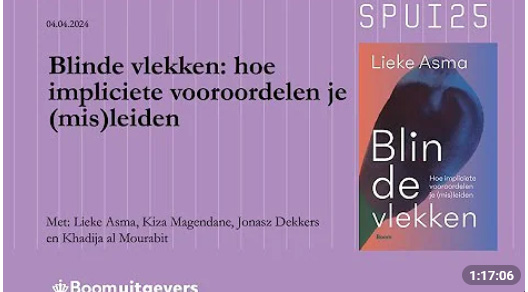
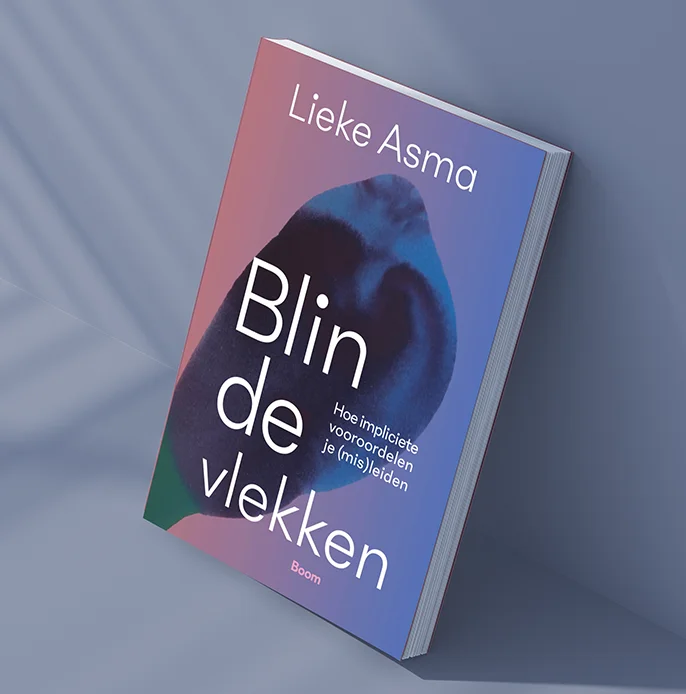
Blinde vlekken
Hoe impliciete vooroordelen je (mis)leiden
On unconscious and unintentional discrimination, and why we understand it better when we view people in their context.
Shortlist Socratesbeker · Longlist Hypatiaprijs
De Standaard ****
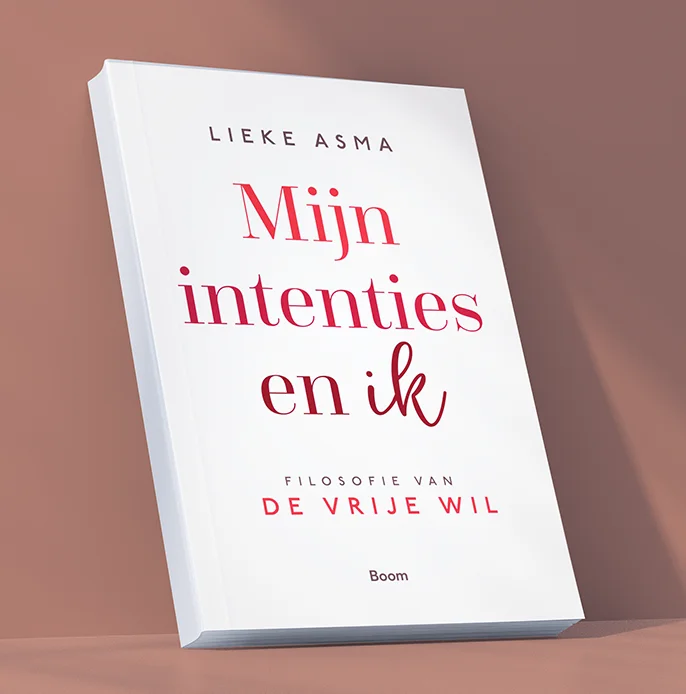
2021
Mijn intenties en ik
De filosofie van de vrije wil
On the question of the extent to which our intentions determine what we do, and what that means for how we view ourselves.
Shortlist Socratesbeker · Shortlist Hypatiaprijs
Media